

Monday Devotional: Between Caesar and God (Mark 12:13-17)
Whose image do you bear?

Then they sent to him some Pharisees and some Herodians to trap him in what he said. And they came and said to him, “Teacher, we know that you are sincere, and show deference to no one; for you do not regard people with partiality, but teach the way of God in accordance with truth. Is it lawful to pay taxes to the emperor, or not? Should we pay them, or should we not?” But knowing their hypocrisy, he said to them, “Why are you putting me to the test? Bring me a denarius and let me see it.” And they brought one. Then he said to them, “Whose head is this, and whose title?” They answered, “The emperor’s.” Jesus said to them, “Give to the emperor the things that are the emperor’s, and to God the things that are God’s.” And they were utterly amazed at him (Mark 12:13-17).
Human beings have a consistent and pernicious tendency to give away our hearts and minds. We latch onto temporal things as if they have eternal value. Yet God is the only source of eternal value. As we make our way through this mortal life we deal with all kinds of relationships, from our relationship with government to that of family, friends, and co-workers. It is easy to find our sense of self—to lodge our ultimate concern—in the ever-fading elements of our everyday existence. Christ teaches us, however, to find our life in him. We are God’s creation, his children who bear his image. Nothing compares in importance to this.
In 11:27-28, the chief priests, scribes, and elders tried to entrap Jesus by questioning him publicly about the source of his authority. The Pharisees and Herodians try their hand at the same thing, only now with a question about paying taxes. These two groups are strange bedfellows. Pharisees were a renewal movement focused on strict adherence to their interpretation of the law. Herodians were political partisans of the Herods, a family not exactly known for its piety. They do have one common cause, however: opposition to Jesus. “The enemy of my enemy is my friend,” so the saying goes.
They approach him with flattery. They praise his sincerity, his impartiality, and the purity of his teaching, though they mean none of it. They are trying to draw him in, to appeal to his ego through public praise. Thus they demonstrate their total misunderstanding of Jesus’ character. Jesus, who has told his followers to take up the cross, who has taught them to serve rather than be served and that the first must be last, will not succumb to flattery. He cares nothing of the honor that comes from public praise. His is an honor rooted in the values of God’s kingdom.
Then they hit him with a question meant to put him on the horns of a dilemma: Is it lawful to pay taxes to the emperor? If he admits it is lawful, he appears to be a Roman sympathizer. He alienates the many who feel the weight of imperial rule, including the taxes that come with it. If he claims that paying the tax is unlawful, however, he comes off as a dissident, perhaps sympathetic to violent factions opposed to Roman rule. Jesus’ message does have political implications, but it is not primarily political. It transcends politics and focuses on a cosmic order rooted in God’s will.
He asks them, then, for a denarius—a Roman coin. The denarius bore a graven image, that of the emperor, in this case probably Tiberius. According to Strauss, the inscription probably read, “Tiberius Caesar, son of the divine Augustus, himself Augustus” (Mark L. Strauss, Mark, HarperCollins Christian Publishing, 2014). The inscription is thus blasphemous for Jews. Jesus is not carrying this coin, but his opponents are. Their concern for what is lawful is a pretense.
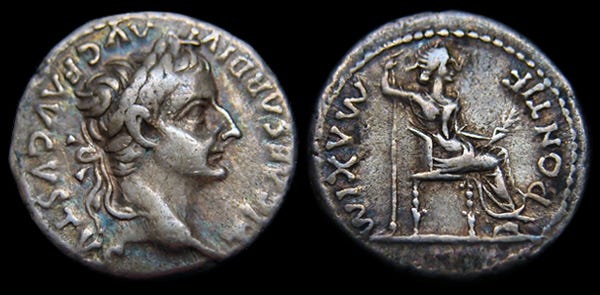
Jesus asks them a simple question: whose head and inscription are on the coin? He knows the answer: the emperor’s. “Give to the emperor the things that are the emperor’s, and to God the things that are God’s,” he replies. What is the significance of this answer? The coin bears the image of Caesar. It thus belongs to Caesar. Human beings, however, bear the image of God. We thus belong to God—not to Caesar. Augustine puts it this way: “The coin has no knowledge of its bearing the image of the prince. But you are the coin of God, and so far highly superior, as possessing mind and even life, so as to know the One whose image you bear” (Oden and Hall, Mark, Ancient Christian Commentary on Scripture).
Yes, we live in the temporal circumstances of this life. Governments, rulers, and taxes are unavoidable elements of human existence. And yet they have no ultimate claim on us. We do not belong to Caesar. We belong to God, and God will judge those who rule alongside those who are ruled. There will be no partiality. In the second century Justin Martyr wrote to the rulers of his day,
So we worship God only, but in temporal matters we gladly serve you, recognizing you as emperors and rulers, and praying that along with your imperial power you may also be found to have a sound mind. Suppose you pay no attention to our prayers and our frank statements about everything. That will not injure us, since we believe, and are convinced without doubt, that everyone will finally experience the restraint of divine judgment in relation to their voluntary actions. Each will be required to give account for the responsibilities which he has been given by God (Oden and Hall).
We may not always serve our governing authorities “gladly,” but we unavoidably participate in the structures that organize our societies. We have certain duties and responsibilities, even allegiances, but all of these are contingent. God comes first. It is his image we bear.
Prayer: Lord, teach me how to navigate the tensions between my earthly citizenship and my heavenly citizenship. Show me how to live faithfully in a fallen world.
Questions:
Do you think Jesus himself paid the tax?
What does it mean for human beings to bear the image of God?
What are some ways in which our Christian faith stands in tension with the temporal government under which we live?