

Character Before Competence
A better vision of Christian leadership
Once you become a Christian, you begin to see the world differently than you did before. God begins to heal your mind, and your perspective changes. This is as true for leadership as for any other area of life. When Christians speak of a “leader,” the term should have its own meaning and form. My mentor at Asbury is Dr. David Gyertson, who has served as the president of multiple institutions of higher education. Dr. Gyertson often speaks of kenotic leadership. This is leadership modeled on Christ’s self-emptying (Greek: kenosis) described in the hymn of Philippians 2:6-11. It’s not an easy way to lead, but it is a Christian way to lead.
About this matter, my friend Cheryl Bridges Johns got me thinking, as she often does:
Dr. Johns suggests, then, that we’ve often overlooked the essential qualities of Christian leaders. Very often, people identified as leaders are:
dynamic
charismatic
decisive
visionary.
There’s nothing wrong with any of these characteristics. In fact they can be very helpful, but in and of themselves they’re insufficient for Christian leadership. So while I’m not ready to ban the term “leadership,” I do think Dr. Johns has something to teach us here.
Leadership and Narcissism
It’s an unfortunate fact that many people who end up in leadership turn out to be narcissists. There’s a reason for this. A 2020 Psychology Today article puts it this way:
Leadership is a natural goal for narcissists because it feeds their motivational goals of status, power, and attention. Not all leaders have narcissistic traits, of course, but it’s certainly common to find narcissistic tendencies in positions of power simply because of the benefits that leadership offers to narcissists.
The article distinguishes between emerging leadership and effective leadership. Emerging leaders are those rising to power. They may or may not, however, be effective once they are in power. “[E]mergent leaders aren’t necessarily effective, and effective leaders don’t always emerge onto the stage in a flashy, attractive way.” Narcissism, they say, is great for emergent leadership, but it has negative consequences for effective leadership.
The church isn’t immune to the emergence of narcissistic leaders. In fact, this is one of our besetting sins. Perhaps if, as Dr. Johns suggested, we focused on discipleship as a prior condition of leadership, we could stop empowering unhealthy people so often.
What Does Jesus Teach?
When Jesus speaks about leadership, he normally does so in terms that challenge both the assumptions of his day and those of our own. For example,
You know that among the Gentiles those whom they recognize as their rulers lord it over them, and their great ones are tyrants over them. But it is not so among you; but whoever wishes to become great among you must be your servant, and whoever wishes to be first among you must be slave of all. For the Son of Man came not to be served but to serve, and to give his life a ransom for many (Mark 10:42-45).
What the NRSV translation misses is the word kai—”even”—at the beginning of the last sentence. “Even the Son of Man came not to be served but to serve, and to give his life as a ransom for many.” In other words, if one as great as the Son of Man came as a servant, what does that say about how you should regard yourself in relationship to others?
We see the same kind of admonition after Jesus washes his disciples’ feet:
Do you know what I have done to you? You call me Teacher and Lord—and you are right, for that is what I am. So if I, your Lord and Teacher, have washed your feet, you also ought to wash one another’s feet. For I have set you an example, that you also should do as I have done to you. Very truly, I tell you, servants are not greater than their master, nor are messengers greater than the one who sent them (John 13:12-16).
Servants are not greater than their masters, and we are Christ’s servants. Jesus didn’t regard it as beneath him to humble himself, and neither should we.
This way of leadership is hard. It doesn’t come naturally to us. (At least, it doesn’t to me.) To lead as a servant, to lead out of humility, requires consistent self-examination. What are my motives? How do I relate to other people? What effect does my language have on others? What do I communicate through my decisions? Does my decision serve me or does it serve the community? Are my actions self-aggrandizing, or do they lift up Christ? To learn to lead in this way requires first that we are disciples of Jesus. We have to learn to follow him, to imitate him, and we do so only in community with other believers. Hence Wesley’s conviction that there is no holiness but social holiness. We need the family of faith to make us holy.
The Ministry of Elders
We can also think about the qualifications for leadership in terms of Christian maturity. Sanctification is something that takes place over the course of a life in which we seek God among his people. Perhaps this is why the Pauline epistles don’t generally talk about leaders, but elders. The implication here is that those who lead in the church have had some time to grow in the faith. They have spent time with the people of God. They’ve been steeped in the power and presence of the Holy Spirit.
Consider this passage from Titus:
I left you behind in Crete for this reason, so that you should put in order what remained to be done, and should appoint elders in every town, as I directed you: someone who is blameless, married only once, whose children are believers, not accused of debauchery and not rebellious. For a bishop, as God’s steward, must be blameless; he must not be arrogant or quick-tempered or addicted to wine or violent or greedy for gain; but he must be hospitable, a lover of goodness, prudent, upright, devout, and self-controlled. He must have a firm grasp of the word that is trustworthy in accordance with the teaching, so that he may be able both to preach with sound doctrine and to refute those who contradict it (Titus 1:5-9).
At the time Titus was written, there was no clear distinction between an elder and a bishop. Whatever is said of one applies to the other. Paul teaches that elders should manage their homes well. Otherwise, how can they be entrusted with the household of God? Their conduct must be righteous. Arrogance, a quick temper, addiction to alcohol, a violent nature, and greed are unacceptable. The elder is one who shows hospitality to others, someone who can be trusted and who exhibits self-control. Moreover, elders must teach in accordance with the truth and even defend the faith when it comes under attack.
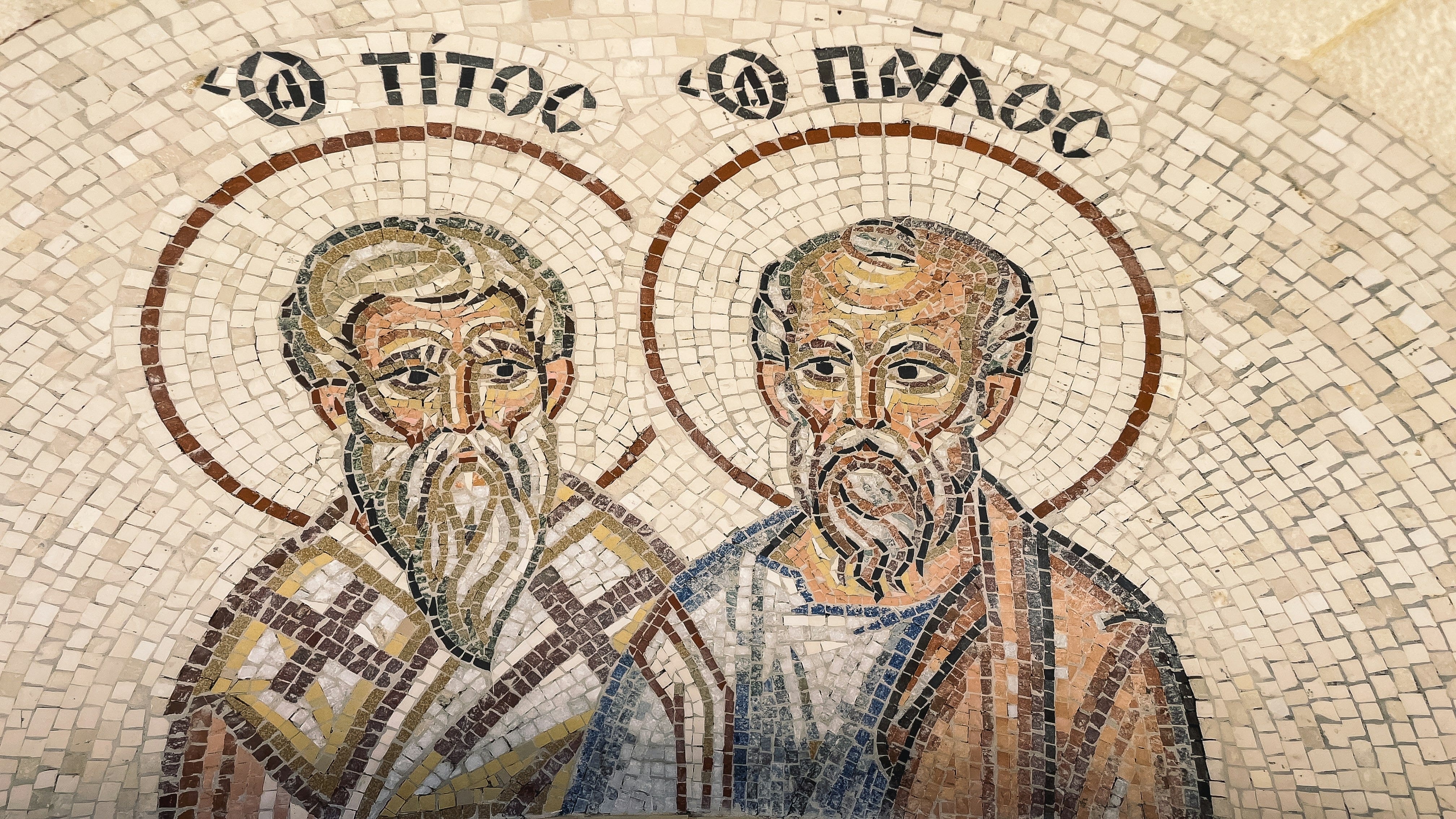
Consider also Peter’s admonition regarding elders:
Now as an elder myself and a witness of the sufferings of Christ, as well as one who shares in the glory to be revealed, I exhort the elders among you to tend the flock of God that is in your charge, exercising the oversight, not under compulsion but willingly, as God would have you do it—not for sordid gain but eagerly. Do not lord it over those in your charge, but be examples to the flock. And when the chief shepherd appears, you will win the crown of glory that never fades away. In the same way, you who are younger must accept the authority of the elders. And all of you must clothe yourselves with humility in your dealings with one another, for “God opposes the proud, but gives grace to the humble” (1 Pet 5:1-5).
Peter roots his own authority as an elder in the sufferings of Christ. It is Christ, not Peter, who is the true exemplar. We will share in his glory, but make no mistake—the glory is his, not ours.
Christian maturity is not simply a function of age. I’ve known young Christians who demonstrate extraordinary maturity in the faith, and I’ve known older Christians who demonstrate very little. Yet while age is not the only factor at play in Christian maturity, we would be foolish to ignore it. I’ve seen Christian leaders implode because they were elevated too quickly. That is a real temptation as we try to identify the next generations to carry the torch of the gospel.
While it’s imperative that we cultivate and empower young leaders in the church, it’s just as imperative that they’re apprenticed to elders. Christian leadership is as much caught as taught. In my life, I have learned volumes by observing those who have gone before me in the faith. I still learn in that way. At fifty-five years of age, I’m perhaps more cognizant than I ever have been of the wisdom of those saints who have long walked with Christ, who have lived out what Eugene Peterson calls “a long obedience in the same direction.”
Elders can guide younger Christians in a variety of ways. They may do so simply by listening to them or by sharing their triumphs and failures with them (both are important). They may hold them accountable in their moral lives. It may be important to encourage younger Christians to seek spiritual direction or Christian counseling.
The ordering of one’s inner life is slow, intentional, and never-ending work. It requires prayer and other means of grace, and at times the guidance of someone with training in this area. Sometimes we call this “spiritual formation,” but it’s more than that. It’s the work that opens us up to the healing power of the Holy Spirit who renews our minds. It is God’s Spirit witnessing within our spirit. It is our intentional “yes” to God’s work of bringing our will into agreement with his. When I was younger, I didn’t think I needed to do this work. Turns out, I really, really did—and still do.
Leaders who are dynamic, charismatic, decisive, and visionary can offer real gifts to the church, but these traits are not enough. Apart from a sanctified character, they can be dangerous. We need leaders who are holy and mature in faith, who have walked with Jesus and his people and learned to love them both. This is not only simple and practical wisdom, but biblical. Both Jesus and Paul knew that the character of our leaders matters, and Christian character is something that is forged in the fires of everyday discipleship.
David, this is such a good post. I am with you 100%. It makes me think that, in addition to the biblical texts you've mentioned, any course on leadership should include the following:
The Didache
1st Clement
The Rule of St Benedict
Julian of Norwich
David Watson has summarized with clarity the essentials for those of us who desire to lead motivated by the highest ideals of Jesus’ calling. Character determines lasting legacy.